

Real-Life Maxxing...
Offline is the new luxury & status symbol

A friend sent me this over the weekend on WhatsApp. Some of you are probably familiar with Autism Capital. His takes are usually on point.
I logged back into X to say that I agreed, and why. It turned into a bit of a long-winded posted so I figured I could elaborate on it here as a longer-form post..
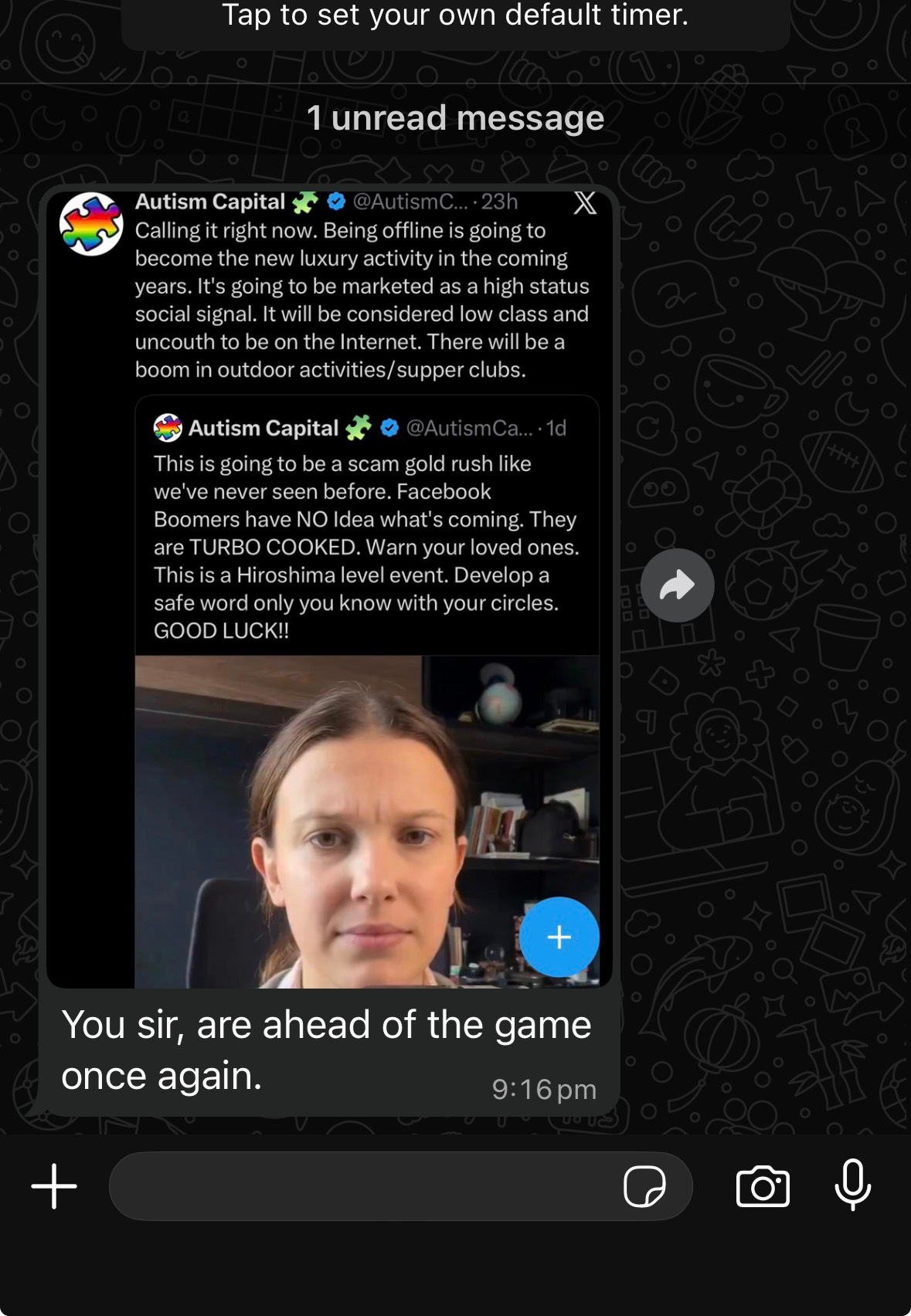
I’ve been mostly offline since the Iryna/Charlie thing in August September - which is about 5mths now.
I can say hand on heart, that my life is objectively better.
I’m healthier, I’m more calm, I have more time in the day which I like to spend with my wife & son or working with my team and I’m significantly more productive.
No doubt the productivity part has a lot to do with the reduction in blue-light radiation from those damn screens, but most important of all, it’s because my mind is not being flooded with or distracted by nonsense I have no power over.
It’s great. I have no idea what is going on in the world, and I couldn’t care less either. Like a once, obviously intelligent man said: Ignorance is bliss.
In my last essay (which if you’ve not read it yet, it’s worth the detour), I specifically spoke to the virtue of deliberate ignorance in a world full of noise.
In this one I’ll lay out my philosophy on real-life maxxing (and how intentional and intelligent ignorance plays a part).
First…some context
The internet is eating itself..
In 2026 the internet feels less human, less alive and less... well...sentient…than it did in 2016, 2006 or even 1996.
It’s eating itself, a bit like an Ouroboros, but a way that’s less cool, and a little more ironic..
The ironic part is that the eating is being done by the two primary spawn of the internet itself: AI and Social media…
The uncool part is that it’s being overrun by low-IQ hordes of normies and screen zombies
On the one hand, AI and Social Media, being essentially “optimisation engines” got so optimised and realistic, that real humans are no longer really necessary to complete the create—> consume loop.
And on the other, we have hundreds of billions of cooked, low IQ normies whose primary skill is…checks notes…ah yes…mindless consumption.
They are the supply side of the equation which a few big producers (that have gotten very good at serving the lowest common denominator of consooomer) sit on the other side of.
So…what are we left with?
The best optimisation engines and best producers become one and the same, achieve scale and grow so big that they basically became the internet - while the consumption side is filled by mindless zombies, both biological & artificial.
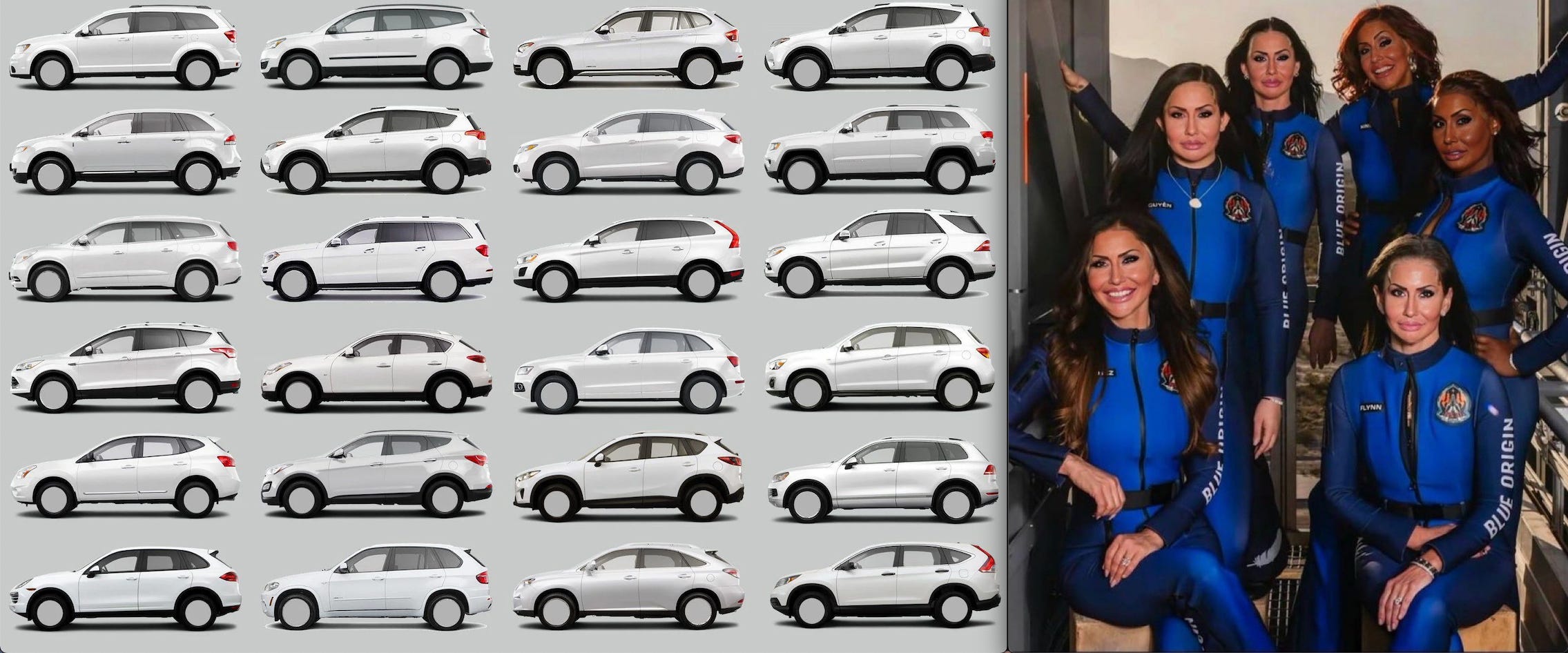
(the price of excessive optimisation —> sameness, ie; noise)
Which leaves us with…yes you guessed it. A dead (or dying) internet
Think about it for a moment. What’s really left of the web besides Amazon, Google, ChatGPT, Netflix, YouTube & the big 3 or 4 social media platforms.
Is time online really spent anywhere else? Is time spent anywhere else?
It reminds me of a once nice American city that is now basically a Target, Walmart, Costco - maybe a Wholefoods - and a whole lot of 3rd world biomass or homeless people on the streets.
Come to think of it, that sounds a little like Santa Monica / Venice Beach California (at least the last time I was there).
It used to be cool. But now…well…I’m sure there’s a few cool things on Abbot Kinney. Gold’s Gym is still a novelty, there’s Erewhon, some nice cafes and I’m sure there’s a few cool house parties here and there. But by and large — someone correct me if I’m wrong — it’s a dump full of homeless bums & drug addicts.
Yes - there are still interesting things and interesting people on the web - but by and large, it’s become a place full of hawkers and big-box online stores servicing a horde of mentally obese consooomers that spend their days scrolling like zombies.
Everyone is intellectually homeless and addicted to a drug called dopamine, which is liberally dispensed by their phone.
Uncouth is the word that Autism used…and I think it’s perfect.
Quantity > Quality
This whole situation lends itself to an environment of perverse incentives where an ever-increasing quantity of low quality slop is churned out for rapid consumption, which just creates more noise, and in turn demands louder, more copious amounts if slop and noise to stand out (for 3 seconds)….
…and so the downward spiral continues.
I could be partially ok with this if there were sections of the internet truly immune to this noise, but I’m no longer sure there are*. The Silicon Valley/Wall Street Industrial complex is such that (a) anything that can get scale, must continue to increase the size of it’s market & sell more stuff, and (b) since these companies get all the money, they get most of the talent.
I know that’s a rather simplistic overview and there’s a lot more nuance - but it’s directionally accurate enough to make the next point, which shall then lead me to how those of us sentient enough to care about all this, can get a ticket out.
*Nostr was a valiant attempt at trying to change the dynamics here but it’s fizzled out, partly because its success depends on capturing attention (which it cannot do, because it’s competing with engines far better at that) and more importantly, because the paradigm it is operating in (and the products built on it - in their current form) are fundamentally about more of the same (content for consumption).
________
So if the normies are going to be cooked and deep-fried online, what about those of us who have been diligently using the internet and social media to learn, grow and become better versions of ourselves?
Well…I believe those days are also coming to an end. I was in this camp for a long time, telling myself I could “tailor my feed” or “train the algorithm.” I moved to Nostr, but found the same thing there, just on a smaller scale. Just more “stuff” I didn’t need.
In the end, I realised it was all just cope. So I came up with a new story..
To find a solution, one must first understand the problem, and the problem is twofold:
Nobody is entirely immune to the siren call of dopamine. These platforms hack your biology in such a way that they hook you. Thus you are not fighting the platform, but your own biology - and this consumes energy. Energy that could be much better spent elsewhere.
Our cups are already full. Those of use who are strong learners have already had our fill, especially if you’ve been online for the last 5 - 10 years. We’re well past the point of diminishing returns. We have all the information we could possibly need to live and lead meaningful lives. Stuffing our minds with more stuff won’t improve anything, and at this point is just a distraction from living in the real world and implementing the things we’ve already learned or know.
It’s a bit like food and eating. No matter how nutritious that steak is, there’s a point at which you’re full and eating another kilo of steak isn’t helping you, but harming you.
In the same way, another life-hack (that you’ll probably never use) or clickbait video about Venezuela, Trump, fluoride in the water, microplastics or civilisational decline (that is probably TRUE) is probably not going to help you.
So what’s the solution?
Before we get to that…(we’re almost there, trust me) a note on status and value..
Status & Value
Not only is the internet is becoming simultaneously full and empty (which is basically the definition of noise), but it’s also becoming low-class and cringe.
A bit like lab-grown meat. Empty stuff which had its heyday and is now about as low-class as you can get when it comes to food.
(if you want a primer on Status, this is certainly one of the best things ever written on it, by fellow Australian Russell Walter):

Real status - as it always has - comes from separating yourself from the masses and doing things they do not and ideally cannot do.
In the near future, that will increasingly mean being OFFLINE as much as possible.
Invisibility and ignorance will become not only luxury items, but virtues — noble and holy ones — acquired and refined through offline living.
Those who have no idea what’s happening online, or in the world for that matter, will be truly alive and elite.
Now, arguably this has always been the case with the upper upper echelons (as argued by Russel above), but in the last couple decades, the classes just below the absolute upper elite have been deriving status through online fame and ‘followings’
But…now that everyone is online…things are changing..
And the beautiful thing about value is that it always migrates to the zone of greatest scarcity.
As a zone attracts more attention (and thus value), it begins to lose scarcity, until it gets saturated, and then one day, the value migrates away to a zone where scarcity prevails.
Today is one such moment of migration. Value is moving back offline not only because of the rise of AI and the enslopification of social media - but also because the door to the web has been opened to “the whole world.”
In the same way mass immigration in the real world lowers the average IQ of the region along with its socio-economic status (and all the cool/smart/wealthy people run away) the average IQ of the internet has fallen drastically so the cool/smart/wealthy people are starting to realise that it’s quickly becoming uncouth and that they need to run away. But where?
The answer: offline. This is going to the only place that the mindless hordes can’t truly follow, either because they can’t afford it, or they’re too busy glued to their screens or VR headsets.
So while we’ve gotten used to the migration happening the other way, where all the cool people came online and status was derived by the number of people following you - this whole dynamic is going (and already starting) to change.
Over the next decade or two, being online will increasingly signal low-status, and being an influencoor will look and feel more like being an OF model: yah sure, you can make money with it - but do people really respect you for it?
Real-Life / Real-World Maxxing
(I still need to figure out what to call it - if you have preference, let me know in the comments)
So what to do with all of this?
The obvious choice is to get more offline (it’s a spectrum). But of course, that’s easier said than done, especially if being online is how you make your money or where you’ve built your network.
Nonetheless, as is the case with everything in life, there are trade-offs. One thing I’m pretty certain of is that the internet is not going to get any better in the short term. The other thing I’m sure of is that we are physical beings.
So…whether it’s now or later, if you want to live in a more wholesome environment and among better people, going offline will be a central part of the strategy.
I think it was Naval who said it (or someone else, I don’t exactly recall), but one of the most important decisions you’re going to make in life is where you physically reside. For a short period of time you could probably argue that was the internet. But I think those days (at least for high quality, high signal people) are numbered.
Where you live and where you spend your time in the real world is going to matter just as much as it did pre-2000s or even more than it ever has in the coming decades.
What else?
At the risk of sounding trite, go build offline communities. This is thrown around a lot, but it’s true. No amount of Zoom calls can ever replace meeting in person and doing things. Time and in-person ordeals build real bonds (amongst both men and women). The trick is finding people with similar values, which the internet, ironically, has and continues to be, very good for (despite the noise).
You should think of the internet — and places like Substack, or to a lesser degree, X — as top-of-funnel parts of this process. The key is to move beyond them. Bennett's Phylactery is doing great stuff with the EXIT Newsletter movement that I recently joined (I recommend you do the same) and I forward to getting more involved with.
They’re doing meetups all the around the US. (Although, mr Bennet - we just need to get you off cringe-fest meetup.com and over to a superior events & community platform - we can discuss this at some point).
There’s more of course, but instead of prescribing what you should do, I’ll finish this post by describing what I am doing. Perhaps you’ll find some inspiration for yourself in there, or you’ll want to get involved.
Real-life maxxing: 2026 edition
Building offline.
I’ve been in tech for 10 years now, building apps, platforms, bitcoin exchanges, language models, social networks and god knows what else.
While building with bits is cool, and technology businesses are obviously more scalable, there’s just something…special…about building with atoms, especially when everyone smart is chasing tech. Leaves a bit of a vacuum elsewhere.
Maybe it’s the contrarian in me, but for the last couple years I’ve had a growing desire to build something offline again. Something physical and tangible that I could touch, smell, feel and “go to.”
Many things came to mind, from simply building a sauna with my bare hands, to building a home (I’ll discuss that further down), to a physical business like a cafe or a premium space for a private mens club.
Not all ideas are created equal, so I had to cull them down. Some things sound nice in theory, but are way more complicated in practice.
I vowed I would never do hospitality again, so that struck out anything food or beverage related and basically anything that requires a lot of staff.
What I landed on is a small, sauna-cold plunge focused social wellness club.
There is going to be a major renaissance in physical space businesses, and it’s already being led by wellness and longevity themes with a “private club” feel. Why? Because people of high status are going offline, and they’re interested in health & want to be a part of clubs. The lemmings who remain online are not.
Just take a look at companies like One&Only or Equinox. They’re constructing some of the most beautiful venues and the core theme is wellness and longevity (for wealthy people seeking status).
Cities like Dubai which have pioneered this approach for many years and are taking it to a whole other level in the coming decade.
Venues like Othership, Bathhouse and the up-coming Moonlight in the US are setting new standards for wellness and offline social connection.
For me, such a project ticks many boxes. It’s small, it’s physical, it has very few moving parts, few staff and most importantly - is something I personally want to frequent and does not exist in my city (or for that matter in the entire country I’m in).
So a couple friends and I are pooling some money, getting some land and building a small, but high quality, members-only sauna/cold plunge recovery centre. It’s going to be a lot of fun.
Next….Building tech that enables better offline living.
As more people go offline, it’s easy to assume that they are going to drop technology and go amish. But I have a more nuanced view here.
This move isn’t being driven by a hate for technology itself. Technology has and always will be an amplifier. What’s going to change — and it’s being driven by what people really want beneath the surface — is the demand for technologies that improve your life, not drain your soul and mental battery.
People want to meet, gather and belong - and they want technology to enhance that, not replace it. This is where things like AR/VR and Metaverse nonsense went wrong and why IMO it will never work. At least not for high quality people. (Perhaps the solution to the hordes is to strap them all into VR goggles and quarantine them there like Curtis Yarvin proposed a long time ago when he was writing as Mencius Moldbug. At this point, I’m not opposed to the idea. If that’s what they want, by all means give it to them. You can’t save the lemmings - but that’s a whole other topic)
For the people reading this, and for those who want to live in the real world: good technology is invisible, and helps humans do what they really want to do most, but better.
So in that vein, we’ve been building a product specifically designed to help people meet and connect offline.
Satlantis started off as an attempt to build a more online social network (not social media) to help location independent or mobility oriented people discover people, places and events based on their social graph. The idea was to merge the best of TripAdvisor, Meetup & Google Maps, with an Instagram-like interface, feed, profile and social layer.
A little more than 12 months on, we not only realised that it was too ambitious, but we more importantly found the piece of that large puzzle that was most valuable and both needed & missing in the world right now.
So we stripped the product back significantly, removed much of the social content and feed related stuff, and have spent the last 6 months building the best community-centric events platform in the world.
Events and community (or clubs as I like to think of them) go hand in hand now. People use events as a tool to build real relationships (community), and the only communities that thrive are the ones who do regular events together to build the necessary bonds. In fact, you could consider a community a kind of recurring, continuous event.
Mainstream event platforms are not built with continuity in mind, or if they are (like Meetup.com), they’re old, outdated and lack the necessary feature-set to run really good ticketed events or generate revenue from it (necessary to keep it alive).
So we’re going to fix this. If you’re running events of any kind, or looking to build IRL community or clubs, then come and check out Satlantis. If you need a hand with anything, just let me know.
That’s enough shilling…next…Living more offline
This one is easier said than done. As much as I am trying to champion this philosophy, my primary work (Satlantis) involves being online.
What I am doing though, is making sure I’m spending as little time as possible on any social platform. That includes Substack. There’s obviously higher quality content here, but as I said above - even consuming more good content is not very useful anymore either. I’ve had my fill.
So…now, instead of reading articles (or god forbid scrolling X), I put my son into the ergo-baby and take him for an hour walk on the beach, and if I really want my mind to wander, I’ll do it while listening to an audiobook (strictly fiction, historic or science, or history - must be a narrative).
Any time that I do need to be in front of the computer, I dedicate it to either collaborative work with the team or calls. I’m endeavouring to consume < 10% of the time, and produce the other 90% or more (also easier said than done).
Travel is the other part. I’m going to show my wife and little son special parts of the world and we’re going to fly in style. I’ve traveled a lot already, but being able to do it with them brings a new dimension to it.
Speaking of new dimensions…this offline living will become more prevalent when I’m ready to build our home..Building a house
At some stage in the next year or two, we’re going to buy some land and build our own house. From scratch, in stages. This year, we’re looking for the land and beginning to put together a moodboard.
For a while I considered buying something - but honestly…fuck that.
The process of building it yourself is so much more meaningful. When I was a teen, I helped both my dad and uncle build their houses, and I can say firsthand that there is something really wholesome about living in a place that you built.
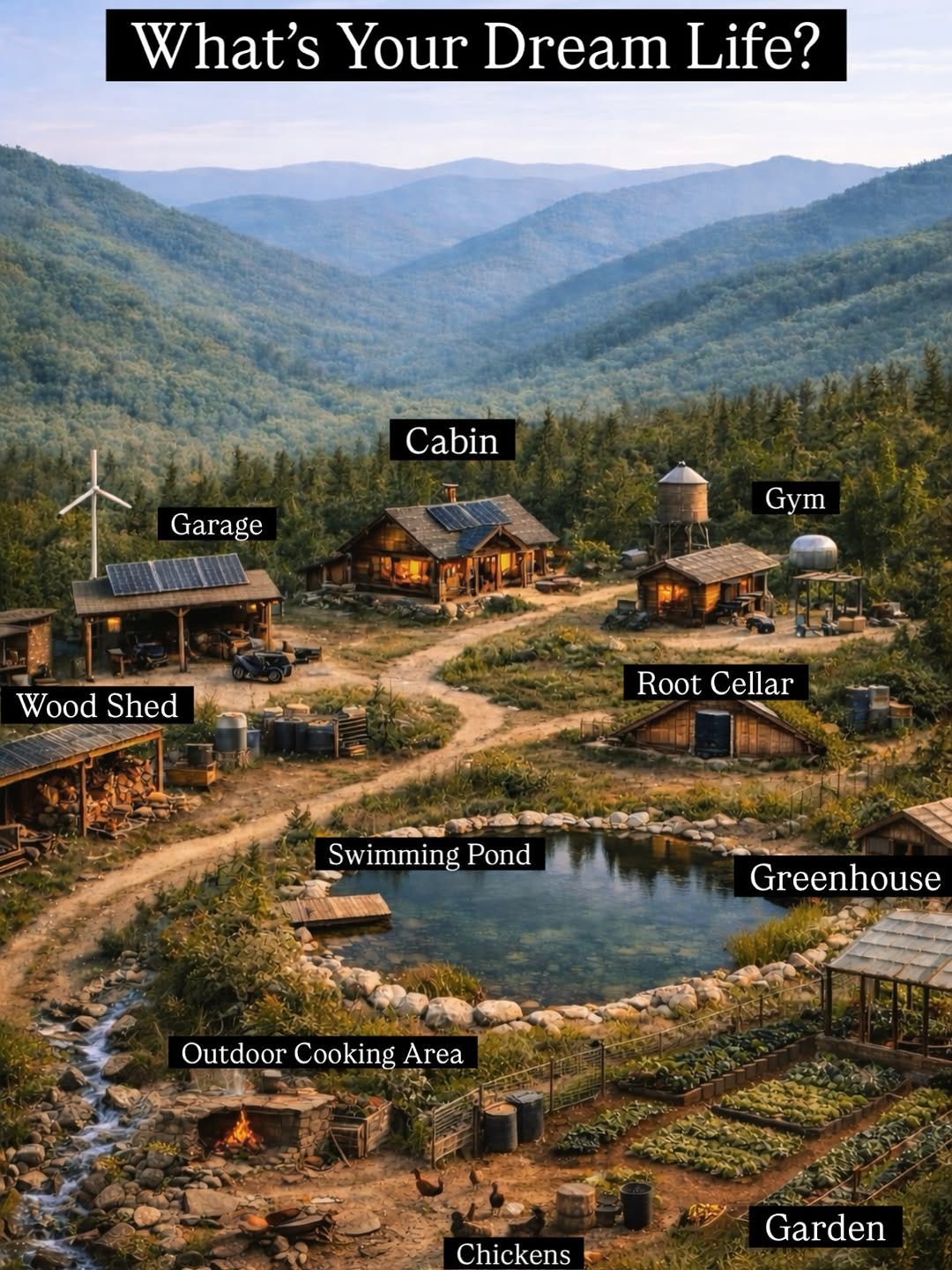
Doing it yourself also allows you to do something like the image below. You can build in stages and really develop something that’s both yours and unique.
Stages also allow you to cashflow it and make a long term project out of it. I’m no fool. I know Bitcoin will keep rising in price, faster than anything else. So why would I blow my load early, when I can build a beautiful place in stages and keep adding to it as (a) Bitcoin goes up in price and (b) my family gets larger and needs more space?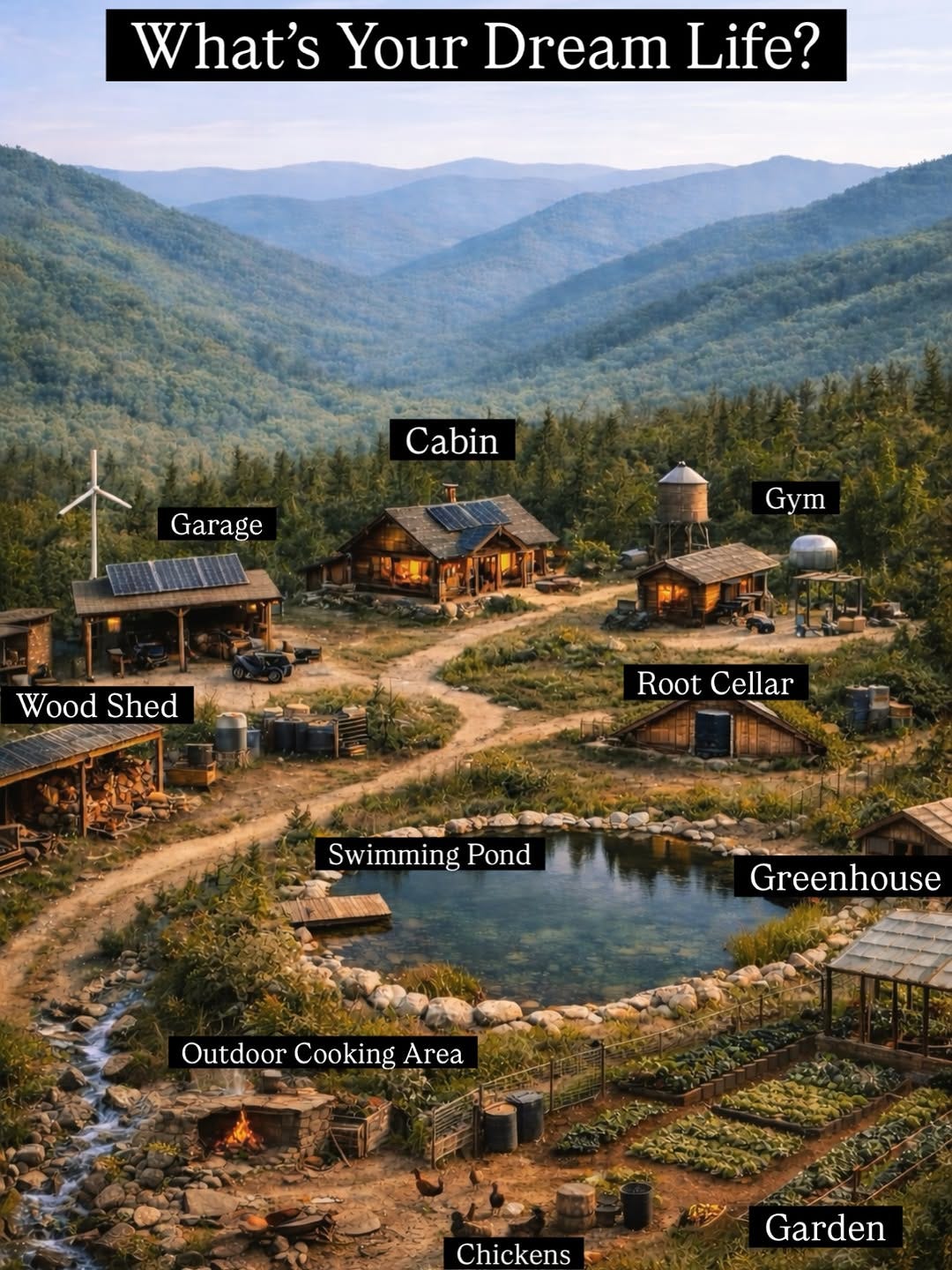
Finally..
Writing long form
I’ll continue writing here on Substack, because I enjoy writing long(er) form. The thing I no longer like is the social aspect. I don’t want another “feed”. So part of me is considering going old school and doing email only...
But we’ll see. For now, the headache of switching is keeping me here so I’ll stick around until I have time to properly migrate to something more simple and designed for broadcasting (not engagement).
So…there you have it.
Real Life and Real World Maxxing.
A way of life that will become more enticing as the online world undergoes a Noah’s Ark level flood of slop.
Hope this was useful.
See you next time.
Aleksandar Svetski
Satlantis.io (if you’re interested)
The thesis about value migrating to scarcity zones makes perfect sense, and it mirrors what happened with organic food - once niche and expensive, then mainstream, and now premium players are differentiating on other dimensions like regenerative practices. The offline-as-luxury prediction feels directionally correct, though the class stratification you're describing might be more nuanced. There's probably a middle tier of people who master selective engagement rather than full disconnection - the ability to use tools without being captured by them being its own form of status. The sauna/cold plunge club model is smart timing given the wellness trajectory.
Hey Alexander. Great summary, this work dovetails nicely with an article I'd written last autumn about digital attention-ecology. I think you'd enjoy that article if you haven't read it already: https://alwaysthehorizon.substack.com/p/artificial-predation-social-media?r=43z8s4
Humanity is going through a population bottleneck. So is the digital environment. There's a selection pressure for resistance to social media dopamine-hacks.